

How Tazapay Helps
Multi-currency Collection
Local virtual accounts in AUD, EUR, SGD, USD and more — buyers pay via local rails, not SWIFT. Local rails are significantly cheaper and faster.
Pooled in Tazapay Wallet
All incoming funds pool into a single Tazapay wallet in your chosen holding currency.
Withdraw / Use at Will
Convert and withdraw to your local bank account when it suits you — not on every transaction. Or utilise this balance for payouts.
Example: A Business in China Collecting Globally in CNY
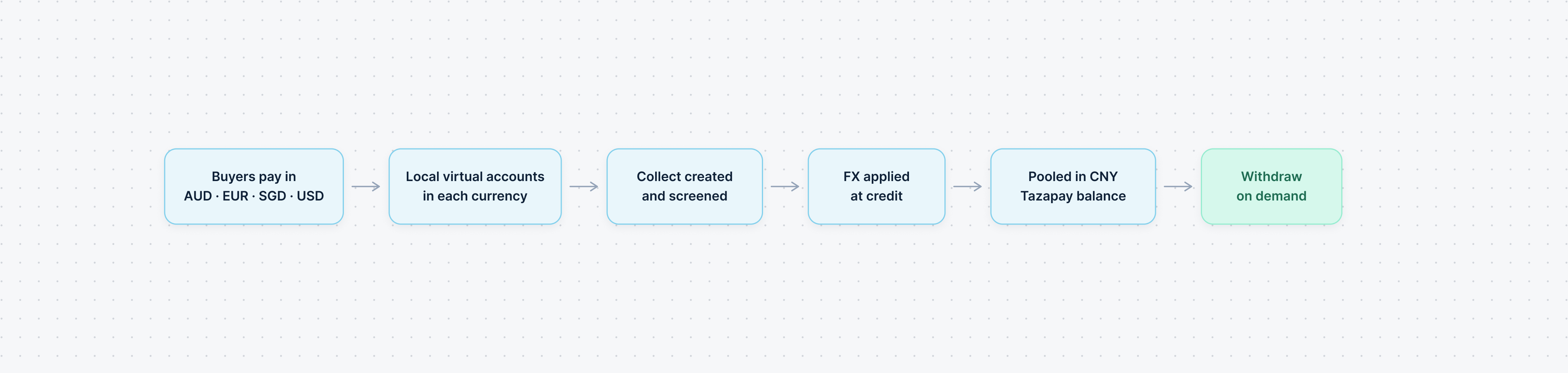
A business in China wants exposure in CNY, but has buyers paying in AUD, EUR, SGD, and USD. The business provisions local virtual accounts in each buyer currency and pools everything into CNY in their Tazapay wallet.1
Request Virtual Accounts
Request virtual accounts in the buyer currencies you need (AUD, EUR, SGD, USD).
2
Share Account Details with Buyers
Share local account details with buyers so they can pay via local rails.
3
Funds Arrive in Tazapay
Each incoming payment creates a collect, which is screened for compliance and credited.
4
Credit with FX Applied
On credit, funds in non-holding currencies are converted to CNY and pooled in the Tazapay wallet — FX happens during the credit, not as a separate step.
5
Withdraw on Demand
Withdraw to the business’s CNY bank account whenever needed.
Flow Diagram
FX happens during credit — there is no separate FX step. Non-CNY collects land directly in the business’s CNY balance with FX applied at the point of credit.
APIs Involved
Tazapay handles:
- Multi-currency local rails
- Compliance screening
- FX conversion to the holding currency at credit time
- Reconciliation across buyer payments