

How Tazapay Helps
Named Virtual Account per Seller
Each seller gets their own Virtual Account linked to their entity ID — every collect is automatically tagged so your ledger knows exactly who was paid.
Entity ID on Every Collect
The
collect.succeeded webhook carries the seller’s entity ID and payment reference, giving your system the signal it needs to credit the right seller.Local Rails + SWIFT
Provision local Virtual Accounts (FAST, ACH, SEPA, Faster Payments, NEFT/IMPS) for in-country buyers, or SWIFT Virtual Accounts for cross-border — buyers pay at local rail cost and speed.
Marketplace-initiated Payouts
Once your ledger shows a seller is due for payout, trigger a payout from your Tazapay balance to the seller’s bank account on their cycle.
Example: ShopHub Marketplace (UAE)
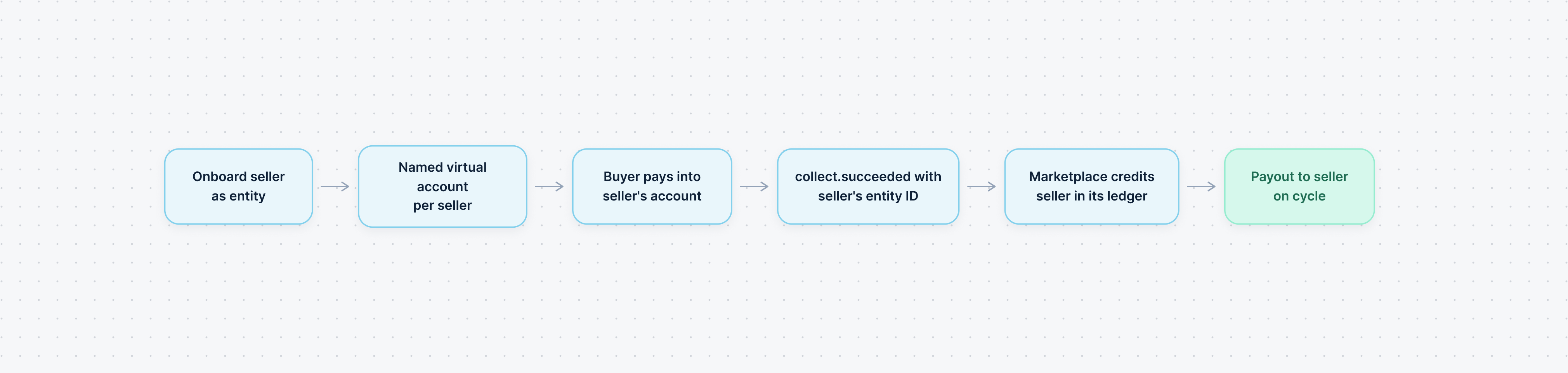
ShopHub is a marketplace operating in UAE. Each seller is onboarded as an entity with a named Virtual Account. Because each Virtual Account is mapped to a specific seller, any payment that lands on a Virtual Account is automatically attributed to that seller.1
Onboard each seller as an entity
Seller X is onboarded as an entity on ShopHub’s Tazapay account. See Connected Accounts.
2
Provision a named Virtual Account per seller
ShopHub calls Create Collection Account for Seller X, scoped to their entity ID (
SELLER_X). This Virtual Account has a unique account number.3
Buyer pays at checkout
A buyer orders an iPhone case worth AED 100 from Seller X. ShopHub directs the payment to Seller X’s Virtual Account.
4
Collect fires with the seller's entity ID
Tazapay credits ShopHub’s Tazapay balance and fires a
collect.succeeded webhook identifying the Virtual Account (SELLER_X) and the amount (AED 100).5
ShopHub credits the seller in its ledger
The Virtual Account maps to Seller X, so ShopHub deducts its 10% commission and credits AED 90 to Seller X’s balance in its ledger.
6
Payout to seller on cycle
On Seller X’s weekly payout day, ShopHub reads Seller X’s ledger balance (say AED 1,847, accumulated across many orders) and triggers a payout via the Create Payout API — from ShopHub’s Tazapay balance — to Seller X’s external bank account.
Flow Diagram
Why this matters
Clean attribution
Every collect arrives with the seller’s entity ID — no manual matching, no ambiguous references. Your ledger knows exactly who earned what.
Scales to any seller count
One named Virtual Account per seller, no matter how many sellers you onboard. Attribution is handled at the collection layer, not reconstructed after the fact.
Marketplace-controlled payouts
Your platform triggers each payout via API on whatever cycle works for your sellers — weekly, monthly, or on-demand.
APIs Involved
What Tazapay handles:
- Named Virtual Account provisioning per seller, linked to their entity ID
- Entity ID on every
collect.succeededwebhook for automatic attribution - Local rail and SWIFT coverage for buyer-side payments
- Marketplace-initiated payouts to seller bank accounts
- Seller ledger: tracking each seller’s balance from webhook data
- Commission deduction logic
- Payout scheduling and seller-facing statements