

How Tazapay Helps
Virtual Accounts at every layer
Provision Virtual Accounts on the FI and on every entity, with consistent attribution down the chain.
Local rails + SWIFT
Provision local Virtual Accounts (FAST, ACH, SEPA, Faster Payments, NEFT/IMPS) for in-country payers, or SWIFT Virtual Accounts for global cross-border collections — pick the rail per use case.
Real-time webhooks
Every credit fires a webhook with the entity, currency, amount, and reference — enabling instant downstream automation.
Pattern 1: Prefund via Local Rails or SWIFT
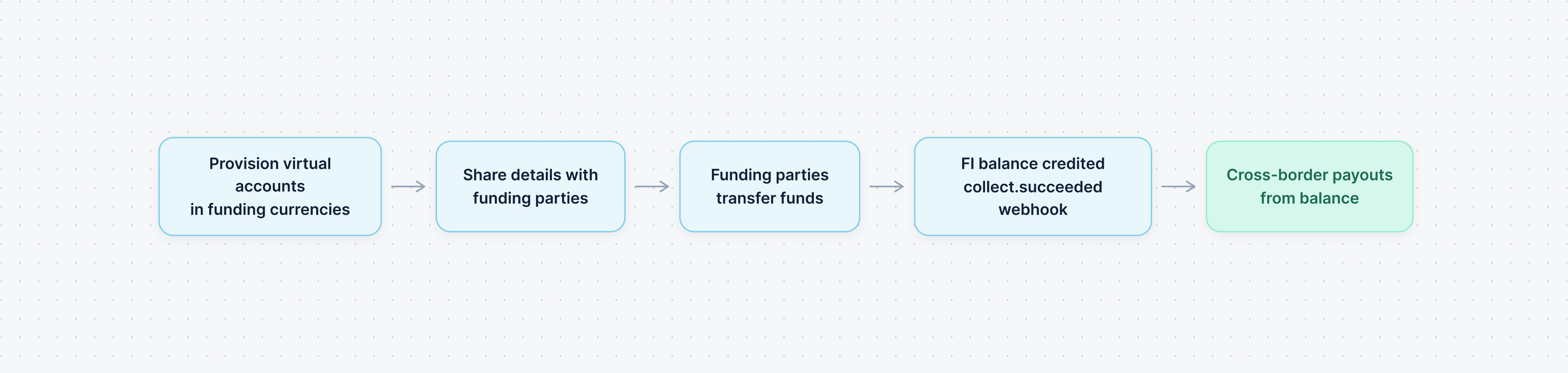
The FI provisions Virtual Accounts on its own Tazapay account to top up its operating balance. The FI’s funding parties — treasury accounts, banking partners, parent company, or external liquidity providers — transfer funds into these Virtual Accounts. Funds credit the FI’s Tazapay balance and are used for downstream cross-border payouts. Local rails (ACH, SEPA, FAST, Faster Payments, NEFT/IMPS, etc.) settle instantly or same-day at low cost. SWIFT Virtual Accounts are also available where the funding party can only send via SWIFT.1
Provision Virtual Accounts in funding currencies
Call the Create Collection Account API to provision a Virtual Account in each currency the FI wants to receive funding in — for example, USD on ACH, EUR on SEPA, SGD on FAST, GBP on Faster Payments. Specify SWIFT if the funding party will only send via SWIFT.
2
Share Virtual Account details with funding parties
The FI shares each Virtual Account’s details (account number, routing number, sort code, IBAN, or SWIFT/BIC) with the parties that will be sending funds.
3
Funding parties transfer
Funds arrive in the Virtual Account via the rail appropriate to that currency and account type.
4
Funds credited to FI balance
Tazapay credits the FI’s balance and fires a
collect.succeeded webhook with the amount, currency, and source details.5
Use balance for cross-border payouts
The FI initiates payouts to beneficiaries globally from its multi-currency Tazapay balance, with FX conversion handled where required.
Pattern 2: Reusable Virtual Accounts for Customer Collections
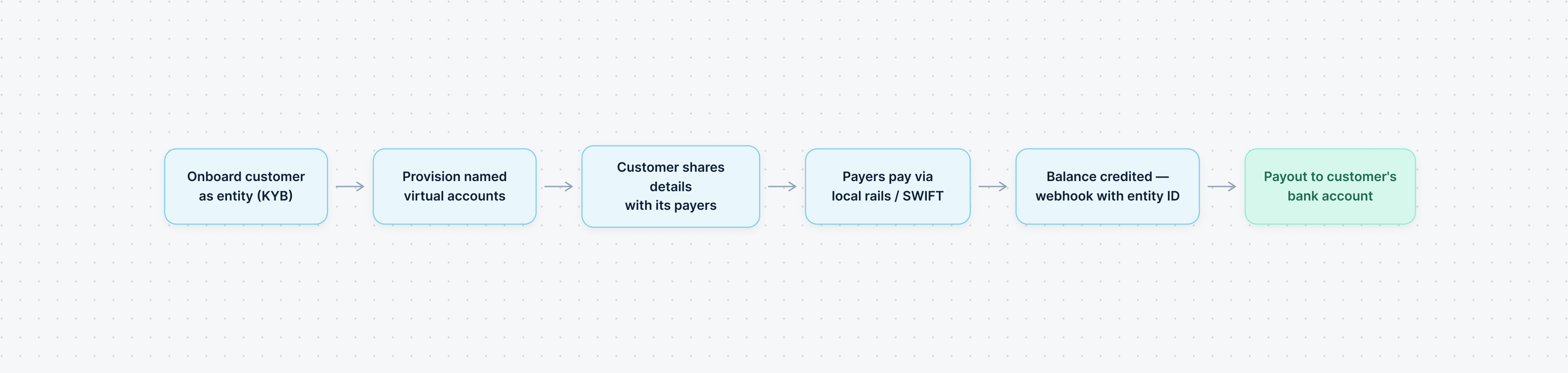
An entity under the FI — for example, an end-business on an AR/invoicing platform — needs to collect payments from its own customers. Each entity gets one or more reusable Virtual Accounts scoped to it. The entity shares the Virtual Account details on invoices, payment links, or customer onboarding flows. Funds flow in via local rails or SWIFT and credit the FI’s Tazapay balance. Every collect is tagged with the entity’s entity ID, so the FI can attribute each credit to the right entity and maintain entity balances in their own system.1
Onboard the entity
The FI calls the Create Entity API to onboard each business as an entity, including KYB and beneficial ownership details.
2
Provision named Virtual Accounts per entity
Call Create Collection Account scoped to the entity. The Virtual Account type depends on where the entity’s payers sit and how they pay:
- Local Virtual Accounts per currency — for entities with payers in known geographies. Provision a local Virtual Account in each currency the entity collects in (e.g., USD on ACH for US customers, GBP on Faster Payments for UK customers, EUR on SEPA for EU customers, SGD on FAST for Singapore customers). Payers transfer at local rail cost and speed and the entity appears local in each market.
- SWIFT Virtual Accounts — for entities with global, low-volume, or high-value B2B payers where maintaining local coverage isn’t justified. A single SWIFT Virtual Account accepts wires from anywhere.
- Both — many entities use local Virtual Accounts in their top 2–3 markets and a SWIFT Virtual Account as a global catch-all for everything else.
3
Entity shares Virtual Account details with its payers
The entity adds the Virtual Account details (account number, IBAN, routing, beneficiary name) to invoices, customer portals, or payment instructions.
4
Payers send funds
Payers transfer via local rails for in-country payments, or via SWIFT for cross-border. Each credit lands in the right named Virtual Account.
5
Funds credited and attributed
Tazapay credits the FI’s balance and fires a
collect.succeeded webhook that includes the entity’s entity ID and payment reference. The FI uses this entity ID to update the entity’s balance in their own system and surface the payment in the entity’s dashboard.6
Entity settles
The FI initiates a payout to the entity’s bank account from the FI’s Tazapay balance.
Choosing the Right Pattern
APIs Involved
Tazapay handles end-to-end:
- Virtual Account provisioning at the FI and at every entity layer
- Both local rails and SWIFT coverage for prefund and customer collections across major currencies
- Compliance and KYC/KYB on entities, and Collections on Behalf Of (COBO) attribution down the chain
- Multi-layer reconciliation so the FI and every entity see clean books at their layer