
Tazapay’s Payouts on Behalf Of (POBO) capability allows platforms / fintechs to initiate payouts on behalf of their customers which can be individual or business. This ensures compliance, traceability, and correct attribution of funds.Documentation Index
Fetch the complete documentation index at: https://developer.tazapay.com/llms.txt
Use this file to discover all available pages before exploring further.
High-level Flow
- Create an Entity (Individual or Business)
- Create a Beneficiary
- Create a Payout using the Entity + Beneficiary
- Handle Payout Events / Webhooks
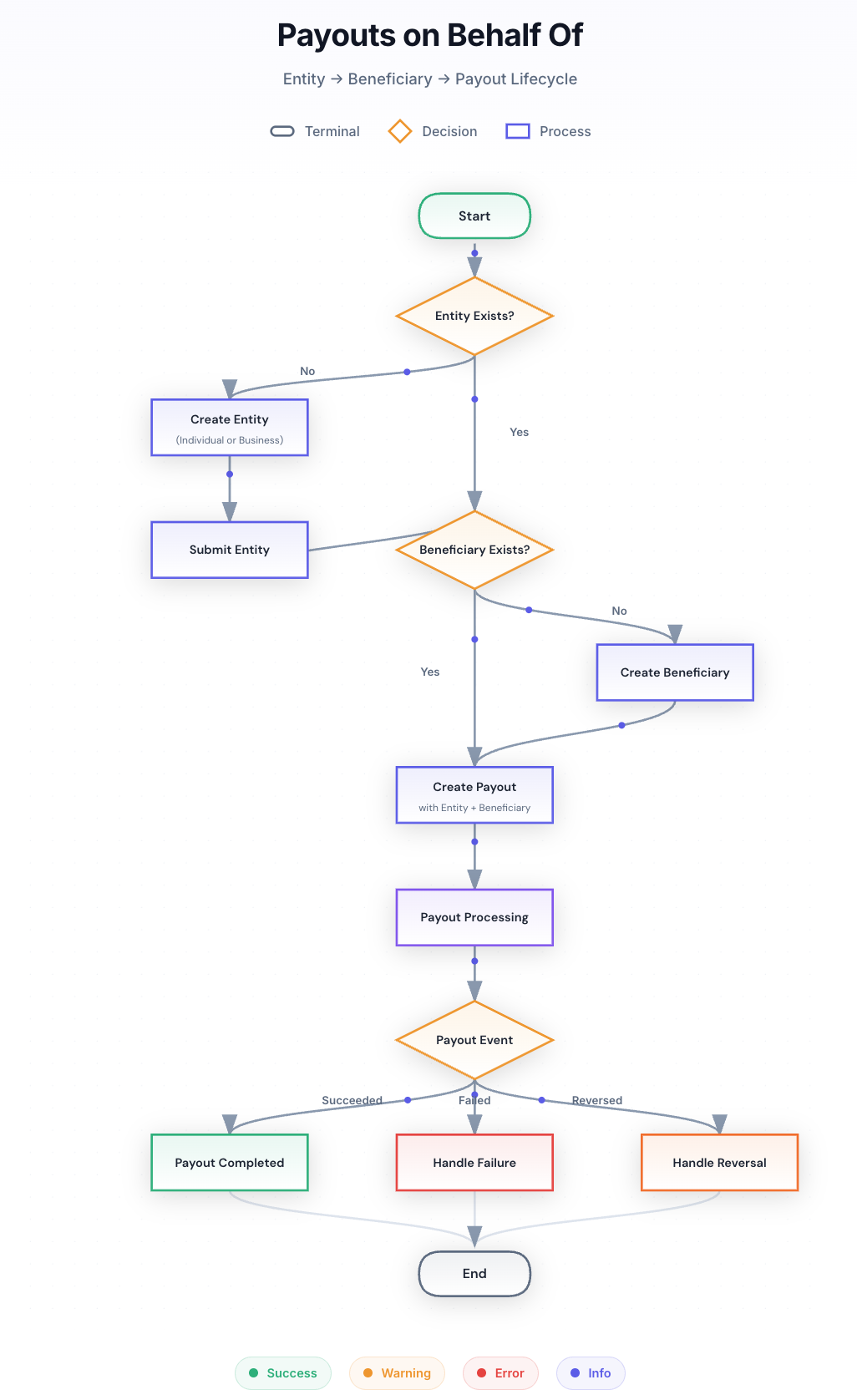
Step 1: Create an Entity (Individual or Business)
An Entity represents a platform’s or fintech’s customer — the party on whose behalf the payout is being made. Every payout must be associated with an entity. Tazapay supports two entity types:- Business Entity – for registered companies
- Individual Entity – for individual customers (e.g., freelancers, creators, sole proprietors)
Relevant Links
- Business Entity Requirements - Full Onboarding
- Individual Entity Requirements - Full Onboarding
- Entity Requirements - Simplified Onboarding
- Create Entity API
- Submit Entity API
Step 2: Create a Beneficiary
A Beneficiary represents the recipient of funds. This can be:- An individual
- A business
- Bank account
- Mobile Wallets
- Local Networks or Proxies
- Stablecoin Wallets
- Another Tazapay account
Relevant Links:
- Create Beneficiary API
- Payout Metadata Bank API - This API lists the beneficiary requirements and transfer limits based on destination country and currency
Step 3: Create a Payout
Once you have:- A submitted entity
- A created beneficiary
Relevant Links:
Create Payout APIStep 4: Handle Payout Events & Webhooks
Tazapay sends webhooks to notify you of payout state changes. You should always rely on webhooks (not polling) for final payout outcomes.Relevant Links:
Best Practices
- Always verify webhook signatures
- Make payout creation idempotent
- Store payout event history for reconciliation